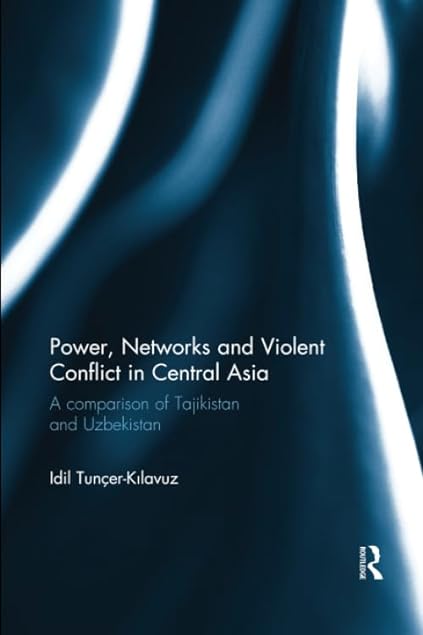
The Tajikistan Civil War (1992-1997) was one of the deadliest post-Soviet conflicts in the former USSR, killing tens of thousands and displacing thousands more. Much of the literature on the conflict has focused on three main factors: 1.) the economic crisis following independence and the consequent loss of subsidies from Moscow; 2.) the regional division of Tajikistan with armed factions roughly divided by region, Garmis and Badakhshanis supporting the opposition, on the one hand, and Khulobis and Khujandis supporting the government, on the other; 3.) the spillover effects of the war in Afghanistan, since Tajikistan shares a long border with Afghanistan and one of the most powerful of Afghan warlords, Ahmad Shah Massoud, was himself a Tajik.
In “Power, Networks and Violent Conflict in Central Asia: A Comparison of Tajikistan and Uzbekistan,” Idil Tunçer-Kılavuz argues that the specific factors cited above as the cause of civil war in Tajikistan as well as the more general causes of civil war cited in conflict theories do not adequately explain the outbreak of civil war in Tajikistan. According to Tunçer-Kılavuz, the same factors cited as the cause of civil war in Tajikistan also existed in Uzbekistan, which did not experience civil war. Both republics were economically almost equal at independence. GDP per capita in Uzbekistan and Tajikistan based on current rouble values in 1991 were 1.603 and 1.404, respectively. Both Uzbekistan and Tajikistan were subsidized almost equally by Moscow (43% and 47% of the republic budget, respectively). Consumer inflation was lower in Tajikistan than in Uzbekistan. Both Uzbekistan and Tajikistan were divided politically on regional lines. In Uzbekistan, there were three more or less equally powerful regional elites based in Samarkand, Tashkent, and Fergana. In Tajikistan, during the republic’s early years, power was shared between elites from Khujand, Garm, Gorno-Badakhshan, and Kulob. However, after 1946, all Tajik Communist Party First Secretaries were from Khujand, although the Soviets maintained the practice of appointing people from different regions to other top posts. Moreover, before the outbreak of civil war in Tajikistan, no conflict existed between different regions of Tajikistan. Intermarriage was common between people from different regions, and people could move freely between regions. Just like in the former Yugoslavia, rather than being a cause of civil war, the war served to solidify regional differences as the cycle of violence and revenge spread throughout the country. Both Uzbekistan and Tajikistan were also affected by the war in Afghanistan. Islamic groups in Namangan and the Islamic Movement of Uzbekistan received support from Afghan factions and later the Taliban, and one of the most powerful Afghan warlords, Abdul Rashid Dostum, is an Uzbek, albeit politically liberal compared to other Afghan warlords. Moreover, there is little evidence to indicate that the Tajik opposition received any support from Afghanistan until 1993, that is, after the outbreak of civil war in Tajikistan. As Tunçer-Kılavuz contends, the Afghan factions were too busy fighting each other for power in Afghanistan to concern themselves with events in Tajikistan.
The same variables existed in Uzbekistan and Tajikistan but produced different results. Why? Tunçer-Kılavuz applies the bargaining theory of war to explain the occurrence of civil war in Tajikistan and its absence in Uzbekistan. According to the bargaining theory of war, war is conceptualized as a bargaining failure. Since war is costly and risky, rational actors and states have a strong incentive for negotiated settlement over the gamble of war. In other words, when a disparity exists between the distribution of power and the distribution of benefits, the actors engage in a process of offers and counter-offers to change the status quo. War is a result of a failure of this bargaining process. If the incumbents overestimate their power vis-à-vis the opposition and underestimate the opposition’s willingness to resist, and the opposition prefers the risky outcome of war to the excessive demands of the incumbents, then war occurs. Actors choose to negotiate or fight based on their power perceptions vis-à-vis their adversaries, and the risk of bargaining failure leading to civil war is highest in cases where both the incumbents and the opposition perceive their power to be high.
According to Tunçer-Kılavuz, differences in the power perceptions of the ruling elite and the opposition explain the occurrence of civil war in Tajikistan and its absence in Uzbekistan. In Uzbekistan, neither the elites nor the opposition had a high enough perception of their power to risk war. On the one hand, the elites felt insecure in their power. During the 1980s, thousands of Party officials were purged and arrested. All Uzbek Party officials felt threatened and united against the centre to protect their interests. Since the power of the elite in Tashkent, Samarkand, and Fergana were almost equal, an agreement was reached on a neutral leader, Islam Karimov, to defend the interests of the whole Uzbek political elite. Being a technocrat and having no independent power base, Karimov was dependent on the elites of Tashkent, Samarkand, and Fergana for support, forcing him to consolidate his power through compromise and negotiation. On the other hand, the opposition could not unite to present a common front against Karimov. Personal and political differences divided the opposition into rival factions as opposed to each other as they were to Karimov. This made it easy for Karimov to divide and rule the opposition. Thus, neither the ruling elite nor the opposition had a high enough power perception to risk war.
In Tajikistan, the elites and the opposition had a high perception of their power. On the one hand, the elite in Tajikistan, unlike in Uzbekistan, did not experience purges or significant changes in the political leadership. Any intra-party challengers were also quickly eliminated. The so-called “Old Guard” felt secure in its control of the country and its ability to deal with the opposition. On the other hand, the opposition had a high perception of its power. After the August coup in 1991, mass demonstrations in Dushanbe forced the resignation of President Qahhor Makhamov, increasing the opposition’s perception of its power. Moreover, during the presidential election in 1991, the opposition united around a single candidate, Davlat Khudonazarov, who received 30% of the vote. However, feeling confident in their power, the ruling elite, led by the newly elected President Rahmon Nabiev, was unwilling to compromise or negotiate with the opposition, which demanded 30% of the power. Instead, President Rahmon Nabiev’s National Guard violently attacked demonstrators in Dushanbe and distributed weapons to pro-government militias. The suppression of the opposition further united the various groups, including the Islamic Renaissance Party (IRP), the Democratic Party of Tajikistan (DPT), Rastokhez, and Lali Badakhshan, forming the United Tajik Opposition (UTO). Thus, the ruling elite and the opposition had a high perception of their power, leading to bargaining failure and civil war.
As Tunçer-Kılavuz writes, “a disparity between the distribution of power and distribution of benefits seems an important factor in the eruption of civil war in Tajikistan.” Nabiev chose war to maintain 100% of the power, but the elite “overestimated its own strength and thought that the opposition would be unable to resist militarily. A successful attack would win them 100 percent of the political power as opposed to the 70 percent offered by the opposition. On the other hand, the opposition supporters, faced with a choice between the uncertainty of war and 0 percent of the political power, chose to resist militarily, reasoning that their power was not weak. If they lost the war, they would end up with nothing, but, by fighting, they stood a chance of winning some portion of the political power. Thus, both sides came to the conclusion that they would benefit from fighting” (p. 97).
Tunçer-Kılavuz’s theory is the most plausible explanation of the origins of the civil war in Tajikistan that I have read to date. The factors frequently cited as the cause of the civil war in Tajikistan, such as ethnic and religious differences, regionalism, separatism, Islamic fundamentalism, and the war in Afghanistan, do not adequately explain the outbreak of civil war in Tajikistan. All these factors also existed in other countries, such as Uzbekistan, which did not experience civil war. Tunçer-Kılavuz does an excellent job at examining the roots of the civil war in Tajikistan in an objective manner that also goes far to explain the outbreak of civil war in other countries.
 T. J. Petrowski